
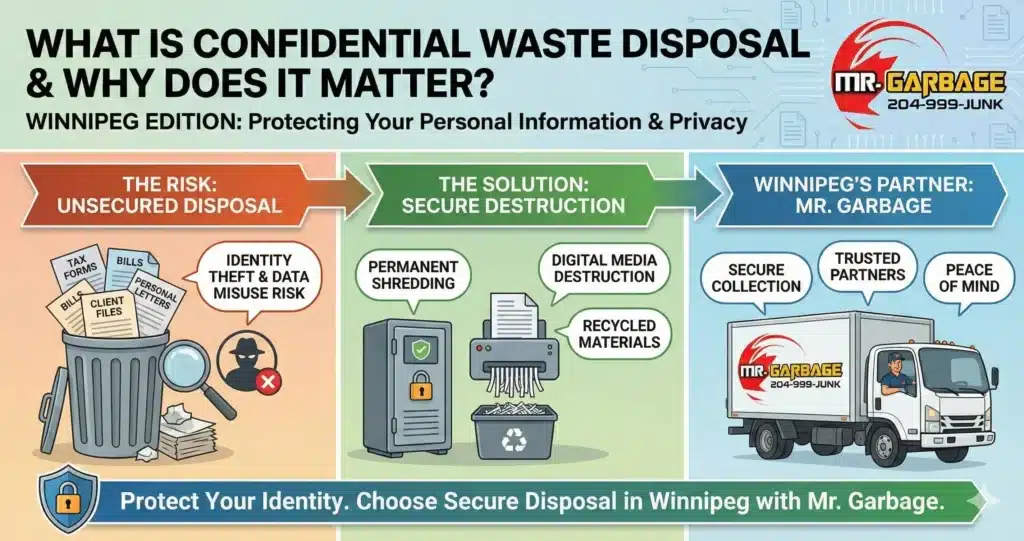
Confidential waste disposal means destroying or securing items that contain private or sensitive information. This includes paper files, printed reports, lists with personal data, and some media. When these items are tossed in a regular bin, they can be found by anyone. That leads to identity theft, fraud, or privacy breaches. For homeowners and small businesses in Winnipeg, secure disposal protects you, your neighbours, and your reputation.
Many Canadian privacy guides say you must destroy personal information when you no longer need it. That helps prevent data loss and keeps you on the right side of the law. The Office of the Privacy Commissioner of Canada gives clear advice on the retention and disposal of personal information.
Who should care about confidential waste disposal?
- Homeowners who discard bank statements, tax papers, or mail.
- Small businesses and home offices that handle client data.
- Landlords and property managers with tenant files.
- Community groups, schools, and clubs with member lists.
If you store any personal information, you need a plan for how to dispose of it safely. Even old documents or notes can be valuable to a thief.
What counts as confidential waste?
Paper and printed material
- Bank and credit statements.
- Tax returns and bills.
- Medical or dental records.
- Client lists and contracts.
Electronic media and devices
- Hard drives, SSDs, and USB sticks.
- CDs and DVDs.
- Mobile phones and tablets (if they store sensitive files).
Mixed or unusual items
- Sticky notes with passwords.
- Drafts of sensitive documents.
- Printed screenshots.
All these items need secure disposal methods. Shredding paper and secure wiping or destruction for digital media are common approaches. Local shredding companies provide on-site or off-site destruction and chain-of-custody documentation.
Why shredding and secure destruction matter
Putting confidential paper into a regular recycling bin is risky. Recyclers often sort materials in open areas. Anyone can pull out stray documents. A shredded document is much harder to reconstruct. Certified shredding companies use industrial shredders that make reconstruction very unlikely. Many providers also recycle the shredded paper, which is better for the environment. Industry leaders in secure shredding explain these steps and provide certificates of destruction.
How to dispose of confidential paper waste
Step 1: Decide what to keep and what to destroy
Check your retention rules. Keep documents that you must by law or for bookkeeping. Anything else you no longer need should be marked for secure destruction. The Office of the Privacy Commissioner recommends destroying personal information once the reason for keeping it ends.
Step 2: Use a locked bin for sensitive papers
Keep a small locked bin or console in your home office. Drop sensitive papers in the bin. Only empty the bin by a trained person or a secure service.
Step 3: Choose on-site or off-site shredding
- On-site (mobile shredding): a shredding truck comes and destroys documents at your location. This is visible and gives immediate proof.
- Off-site: your documents go to a secure facility for shredding and recycling. You get a certificate of destruction.
Local providers in Winnipeg offer both options. Ask for chain-of-custody documentation.
Step 4: Recycle shredded paper responsibly
Most shredding providers recycle the shreds. This is better than landfill and keeps your disposal environmentally sound. Ask your provider about their recycling practices.
Step 5: Wipe or destroy electronic media securely
Before recycling or disposing of devices, wipe data using approved tools or use a certified destruction service for drives and phones. Cybersecurity guidance outlines secure media sanitization steps for public and private organizations.
How to dispose of confidential paper waste at home
- Tear or cross-shred highly sensitive pages if you have a personal shredder.
- Remove staples and binder clips so shredders can process paper safely.
- For very sensitive items, use a certified shredding service rather than a home shredder.
- Keep a small bin for mail that needs shredding. Empty it on delivery day to avoid overflow.
These small routines reduce risk and make disposal a habit.
Choosing a secure, confidential waste disposal provider in Winnipeg
When you search for confidential waste disposal near me, use this checklist:
- Do they offer on-site and off-site shredding? Ask which they recommend for your needs.
- Can they provide a certificate of destruction? This is proof that the job is done.
- Do they recycle shredded paper? Choose firms that balance security and sustainability.
- Do they handle electronic media destruction? If you need drives or phones destroyed, confirm the method.
- Can they supply secure bins or consoles for ongoing use? Many offices and home offices find this useful.
Local Winnipeg options include national firms and regional providers. Compare services and request references from other Winnipeg customers.
Legal and privacy obligations in Canada
Canada’s privacy rules require organizations to protect personal information throughout its lifecycle. That includes secure disposal. PIPEDA applies to private-sector organizations and emphasizes reasonable safeguards. Provincial laws may add further rules for health or public-sector data. Even as a homeowner or small business, following secure disposal practices supports privacy and reduces the risk of complaints or fines. Official guidance on retention and disposal helps set your policies.
Secure disposal for businesses: extra steps
If you run a small business, add these steps to your plan:
- Create an information destruction policy. Spell out retention times and disposal methods.
- Train employees on what to keep and how to discard.
- Use locked consoles in public areas and staff-only bins in offices.
- Keep manifests and certificates for major document purges.
- Vet vendors for compliance and insurance.
These steps protect customer data and your business reputation. Many business-focused shredding services provide tailored programs and recurring pickups.
Digital data and confidential waste disposal
Confidential waste isn’t only paper. Data on devices is also at risk. Follow these rules for digital media:
- Back up what you need and erase the rest securely.
- Use certified data-wiping tools for drives you will reuse.
- For drives to be retired, use certified destruction services that pulverize or shred drives.
- Ask for proof of destruction and recycling for electronic remnants.
Canada’s cyber guidance and media sanitization standards give clear methods for erasing or destroying data. Follow them before handing over devices to any waste stream.
Environmental notes: secure destruction and recycling
Shredding need not be wasteful. Many providers recycle shredded paper into new paper products. For electronics, certified recyclers recover metals and components. Ask your vendor how they recycle post-destruction material. Choose providers who balance secure destruction with responsible disposal.
Large firms in Winnipeg and national providers state they recycle shredded material and follow environmental standards. Ask for details about the recycling chain if this matters to you.
Real-world example: a Winnipeg household
A homeowner in Winnipeg found old tax returns and medical letters in a closet. They used a local mobile shredding service. The truck shredded documents on site and issued a certificate afterward. The homeowner then placed shredded paper in the recycling. This simple action closed a potential privacy gap and gave peace of mind.
Many neighbours and small offices use similar services when moving houses or clearing basements. It’s a practical, low-stress way to deal with years of accumulated paper.
Expert perspective
“A clear, written disposal plan is the best defence against accidental data loss,” says Karen Patel, Privacy Compliance Consultant (Winnipeg). “Small steps like locked bins, routine shredding, and vendor checks make a big difference. For businesses, documentation of destruction proves you took reasonable steps.”
This viewpoint matches federal guidance: destroy personal information when you no longer need it and keep records of destruction where appropriate.
How Mr. Garbage can help
Mr. Garbage works with secure shredding partners to support Winnipeg homeowners and small businesses. We can:
- Arrange on-site or off-site shredding.
- Supply locked consoles or secure bins for regular use.
- Provide certificates of destruction for audits or peace of mind.
- Coordinate electronic media destruction with certified recyclers.
If you need recurring pickups or a one-time purge, we can match you with a trusted local provider. Learn about options and local rules before you schedule. (See local providers like Shredit and Iron Mountain for examples of services available in Winnipeg.)
Quick checklist: how to dispose of confidential paper waste today
- Sort documents you no longer need.
- Put them in a locked shredding bin.
- Choose on-site or off-site shredding.
- Ask for a certificate of destruction.
- Recycle shredded paper when possible.
- Securely erase or destroy electronic media before disposal.
Use this checklist whenever you clear out files, move, or change systems.
Conclusion
Confidential waste disposal is simple when you make a plan. Know what to keep and what to destroy. Use locked bins and certified shredders. Wipe or destroy electronic media before disposal. Ask for certificates of destruction and choose providers that recycle responsibly.
If you’re in Winnipeg and want help with confidential waste disposal, Mr. Garbage can connect you with trusted local shredding partners and arrange secure pickups. Protect your privacy today and make disposal a routine part of your home or business practices.
Ready to clear out old files safely? Contact Mr. Garbage to set up on-site or off-site shredding and get a certificate of destruction.
Frequently Asked Questions (FAQs)
Q1: What is confidential waste disposal?
A1: Confidential waste disposal is the secure destruction or sanitization of items that contain private information, such as bank statements, medical records, or digital drives. Proper disposal prevents unauthorized access and reduces identity theft risk.
Q2: How do I dispose of confidential paper waste at home?
A2: Keep a locked bin for sensitive papers. Use a personal shredder or hire a certified shredding service. For large amounts, a mobile on-site shredding truck is the safest option. Always recycle shredded paper if the provider does.
Q3: Are there secure disposal services near me in Winnipeg?
A3: Yes. Winnipeg has national and local shredding services offering on-site and off-site destruction. Examples include national firms and local providers that supply secure bins and certificates of destruction. Ask for references and recycling details.
Q4: What should businesses include in a confidential waste policy?
A4: Include retention schedules, secure storage, employee training, vendor selection criteria, destruction documentation, and procedures for electronic media. Regular audits help ensure compliance.
Q5: How do I securely dispose of old hard drives or phones?
A5: Use certified media sanitization tools or a destruction service that pulverizes or shreds drives. Ask for a certificate of destruction and for proof that the recycler follows environmental standards. Follow cyber guidance for media sanitization before disposal.
Sources and further reading
- Office of the Privacy Commissioner of Canada: Guidance on retention and disposal of personal information.
- Shredit: Secure shredding services and best practices.
- Iron Mountain: Records management, secure shredding, and certified destruction.
- Canadian cybersecurity guidance: IT media sanitization and secure disposal of electronic media.