
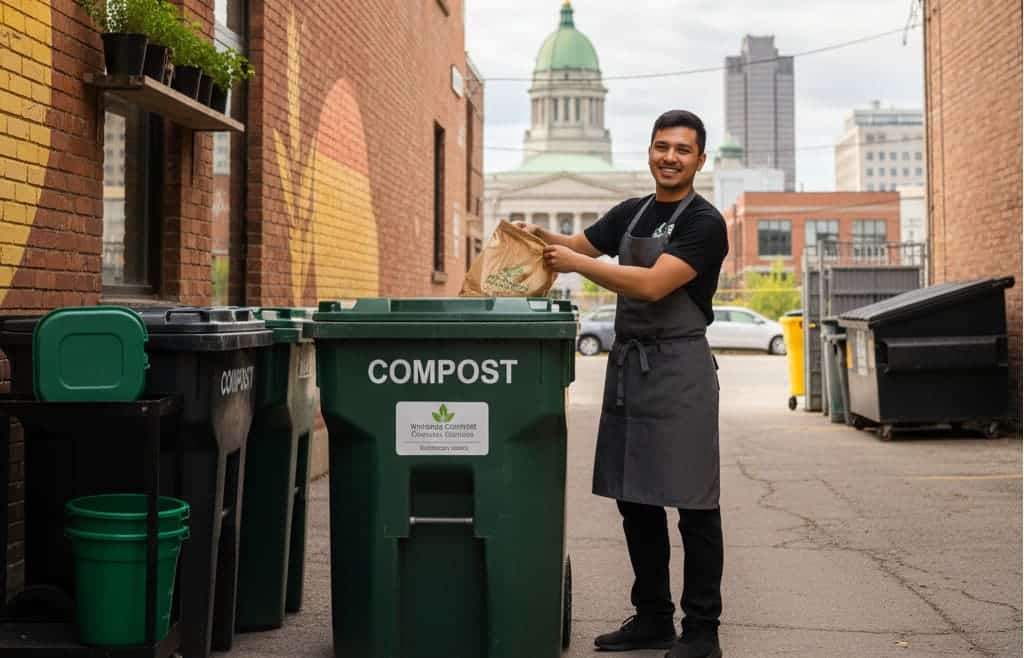
If you run a restaurant in Winnipeg, you know food waste piles up fast: peels, trimmings, leftovers, coffee grounds. Sending all that to landfill is costly for the planet. But you do have a better option: restaurant compost services.
“Restaurant compost” means collecting organic food waste separately, then sending it for composting instead of treating it as regular garbage. For many restaurants, this small change can make a big difference.
This post explains why composting matters, what restaurant compost services look like in Winnipeg, and how you can use them for your business.
Why Restaurants Should Consider Composting
Food waste is a major problem and opportunity.
Across Canada, a large share of waste from food service ends up in landfills. According to a national report, about 40% of municipal waste in Canada is organic waste, such as food, yard, and wood. That includes waste from restaurants and other businesses. Government of Manitoba
When food waste goes to a landfill, it decomposes without oxygen and produces methane. Methane contributes to greenhouse gas emissions. Composting food waste instead reduces the environmental impact. Canada
Composting offers benefits to the environment and your business.
By separating and composting food waste, restaurants help reduce landfill burden. Compost returns nutrients to the soil, supports local gardens or agriculture, and helps build a circular waste system.
Also, composting helps reduce odors, pests, and contamination risks compared with sending mixed waste to a landfill.
Many restaurants, even busy ones, can redirect most of their organic waste into compost bins. Some studies claim up to 90-95% of restaurant waste (food scraps, compostable disposables, and certain paper) can be composted. roadrunnerwm.com
Composting Infrastructure in Winnipeg and Manitoba
Compost services and facilities
In Winnipeg, the local waste system supports composting. The municipal waste authority lists composting of kitchen and yard waste as a way to reduce landfill load.
Beyond homes, there are services for businesses and institutions. For example, Compost Winnipeg, an initiative of Green Action Centre, offers commercial composting services for restaurants, businesses, and institutions. fireweedfoodcoop.localfoodmarketplace.com
Compost Winnipeg provides bins, regular pick-ups, sorting guidance, and tracks organics diversion for clients. That makes composting manageable even for busy kitchens.
Government support and environmental importance
Per provincial guidelines under the WasteWise Manitoba program, organic waste (food, yard, wood waste) makes up a large share of total waste. Composting organic waste is encouraged as a way to reduce landfill pressure, reduce greenhouse gas emissions, and improve soil health. Government of Manitoba
This makes composting not just a “green choice,” but a practical waste-management strategy for businesses in Winnipeg and Manitoba.
What Restaurant Composting Looks Like in Practice
Here’s how restaurants in Winnipeg can implement composting with a service provider:
Separate organic waste at source
- Use separate bins or buckets for food scraps, vegetable peels, coffee grounds, compostable paper/napkins, etc.
- Keep these bins accessible in the kitchen/ prep areas. Use liners or compostable bags if needed.
- Avoid putting non-compostable items: plastic wrappers, metal, glass, or chemicals.
Use appropriate compost bins for restaurants.
A commercial partner (like Compost Winnipeg or a private hauler) can provide dedicated compost bins. They may come in sizes from small containers (for back-of-house kitchen use) to larger bins (for frequent disposal).
Bins should be clearly labeled to avoid contamination. Staff training matters and makes sure everyone knows what is compostable.
Arrange regular pickup or drop-off.
Depending on waste volume, compost bins may need pickup daily, several times a week, or weekly. A trustworthy compost service handles pickup and transports waste to licensed composting facilities. Compost Winnipeg, for instance, collects waste from businesses and institutions across the city.
After processing, organic waste gets turned into nutrient-rich compost that can be reused in landscaping, gardening, or agriculture.
Track waste diversion and promote accountability
A good compost service can provide reports showing how much waste you diverted from the landfill. That helps quantify your environmental impact. Compost Winnipeg reportedly gives regular diversion reports to clients. fireweedfoodcoop.localfoodmarketplace.com
This transparency helps businesses stay accountable, and can also be part of sustainability reporting or marketing (showing customers you care about the planet).
Why Restaurant Compost Services Matter in Winnipeg
Environmental impact
- Composting reduces methane emissions from landfills. Methane is a potent greenhouse gas.
- Diverting organic waste eases pressure on landfill capacity. It helps landfills last longer.
- Compost improves soil quality when applied, benefiting gardens, green spaces, and maybe local farms.
Business & community benefits
- Restaurants show they care about sustainability, which is good for their reputation among eco-conscious customers. WebstaurantStore
- Less mixed waste volume can reduce disposal hassles, odor, and pests.
- Possibility of reusing compost locally (if allowed) for landscaping or community gardens.
Alignment with local and national waste-reduction goals
Canada aims to reduce food waste across the supply chain. According to a federal report, a large share of food produced ends up wasted at retail, in households, and in food services (restaurants included). Composting is a practical step toward reducing that waste and meeting sustainability targets. Canada
In Manitoba, composting of organic waste is encouraged as part of responsible waste management.
How a Waste Management Company Like Mr. Garbage Can Help
If you run a small restaurant, café, or food-service outlet and don’t want to manage composting yourself, a provider like Mr. Garbage can help.
- They can arrange compost-bin delivery, pickup, and disposal.
- They can advise on what waste is compostable.
- They can coordinate with licensed composting facilities in Winnipeg or Manitoba.
- They can schedule regular pickups based on your waste generation, so you don’t worry about overflow.
With such support, you can focus on your business, not waste on logistics.
Practical Steps to Start Composting at Your Restaurant in Winnipeg
- Audit your waste for a week. See how much organic waste you generate.
- Contact a compost-service provider (Compost Winnipeg or Mr. Garbage) and describe your waste type and volume.
- Get compost bins suitable for your kitchen and waste output.
- Train your staff. Make sure they separate waste properly: only compostable items go in compost bins.
- Set up a regular pickup or drop-off schedule.
- Track your diverted waste. Review periodically. Adjust bin size or frequency if needed.
This simple approach helps turn waste into a resource and makes your restaurant greener.
Example: Small Café in Winnipeg Implements Composting
Imagine a small café in downtown Winnipeg. They generate food scraps, coffee grounds, napkins, leftover fruit, and biodegradable coffee filters. Each day, they throw away several kitchen bins of mixed waste.
They partner with a compost service in Winnipeg. They place a compost bin beside their kitchen garbage area. Staff separate compostable scraps during food prep and cleaning. Once full, the compost bin is picked up by the hauler.
Over time, the café tracks how much waste it diverts. The volume of regular garbage bins shrinks, and compostable waste goes to licensed composting. The café lowers its environmental footprint, improves hygiene, and signals to customers it cares about sustainability.
That’s the value of restaurant compost.
Challenges and How to Handle Them
Composting isn’t always easy. Restaurants face issues such as:
- Contamination: Non-compostable items ending up in the compost bin. Solution: clear staff training, good signage, and separate containers.
- Odour and pests: Organic waste can smell or attract pests. Solution: use sealed bins, schedule frequent pickup, and store bins in a cool area.
- Regulation and compliance: Some waste (meat, bones, dairy, oils) may not be accepted in certain compost systems. Check with your provider or local composting rules. For example, the city’s composting guidelines for households ban meat, oils, and dairy. City of Winnipeg
- Logistics for small kitchens: Small kitchens may not produce enough waste to justify large bin pickups. Solution: partner with nearby businesses or opt for shared/commercial compost services that aggregate waste.
With planning and a reliable provider, these challenges can be managed.
Conclusion
Restaurant compost services in Winnipeg offer a smart, practical way to reduce food waste, lower environmental impact, and support sustainable waste management. By collecting food scraps and organic waste separately and working with a licensed provider, restaurants can divert waste from landfills.
Services like Compost Winnipeg or Mr. Garbage make it easier. They supply bins, handle pickup, and ensure compost goes to proper facilities. For any food-service business in Winnipeg, composting is not just a nice idea; it’s a practical and responsible business move.
If you run a café, restaurant, or catering service, consider setting up compost bins with Mr. Garbage today. Contact them, and get your compost program started.
Frequently Asked Questions (FAQs)
Q1: What kinds of waste from restaurants can be composted in Winnipeg?
A: Food scraps, vegetable and fruit peels, coffee grounds, tea leaves, compostable paper napkins and unbleached paper, coffee filters, and biodegradable food packaging, if accepted by your compost provider. Avoid chemicals, oils, grease, meat, dairy, and non-compostable plastics.
Q2: Does Winnipeg have compost services for restaurants and businesses?
A: Yes. Compost Winnipeg (run by Green Action Centre) offers commercial compost services for restaurants and businesses. They supply compost bins and provide regular pickup across Winnipeg.
Q3: Why is composting restaurant waste better than sending it to a landfill?
A: Composting prevents food waste from decomposing anaerobically in a landfill, which produces methane, a potent greenhouse gas. Compost returns nutrients to soil, supports gardens and landscaping, and reduces pressure on landfill capacity.
Q4: How often should a restaurant’s compost bin be collected?
A: It depends on how much organic waste the restaurant produces. For many kitchens, weekly pickup works. For larger operations or high-volume days, more frequent pickup may be needed. A compost service provider can advise and schedule pickups accordingly.
Q5: How do I begin composting for my restaurant in Winnipeg?
A: Start by auditing your waste for a few days to see how much compostable waste you generate. Then contact a compost service (like Mr. Garbage or Compost Winnipeg), get bins, train staff for separation, and set up regular pickup. Review periodically and adjust as needed.